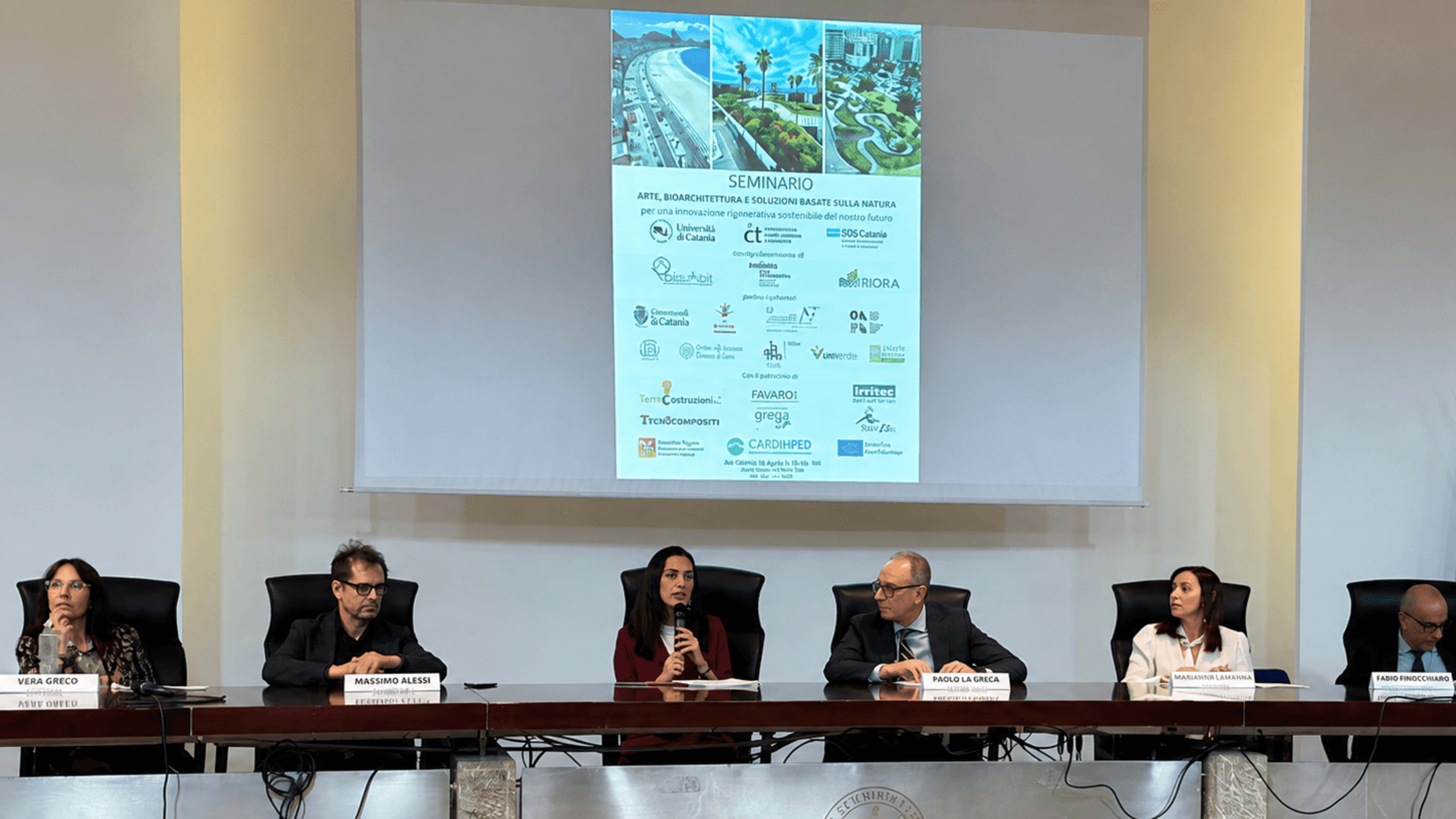
On 22 May 2026, the Aula Magna of the Department of Agriculture, Food and Environment at the University of Catania hosted the seminar "Art, Bioarchitecture and Nature-Based Solutions: Towards a New Culture of Environmental and Urban Regeneration."
Favaro1 proudly supported the initiative, promoted by the University of Catania (Di3A) and CSEI Catania as part of the European CARDIMED project, as it reflects the company's commitment to creating more resilient, sustainable and climate-responsive urban environments.
Bringing Research, Design and Practice Together
The seminar brought together researchers, designers, public institutions, professional associations and companies to discuss the role of Nature-Based Solutions (NbS) in addressing today's environmental and urban challenges.
The event promoted an interdisciplinary dialogue between landscape architecture, agronomy, engineering, geology and urban planning, encouraging a shared vision for the regeneration of Mediterranean cities, increasingly exposed to climate, environmental and social pressures.
The strong participation of professionals, academics, public authorities and industry representatives confirmed the growing interest in innovative approaches to ecological transition and sustainable urban development.
Key Highlights
The programme featured internationally renowned speakers and case studies exploring the relationship between landscape, water management and climate resilience.
Among the main topics discussed:
- the design legacy of Roberto Burle Marx and its relevance to contemporary cities;
- conservation and management of UNESCO modern landscapes;
- sustainable post-disaster reconstruction strategies;
- green infrastructure and ecological restoration;
- Nature-Based Solutions for sustainable stormwater management;
- the role of geological systems and landscape in building resilient cities.
Particularly inspiring was the presentation by Magdalena Gajewska from the Gdańsk University of Technology, who shared practical examples of how Nature-Based Solutions can improve urban water management while enhancing environmental quality and climate resilience.
Professor Giuseppe Luigi Cirelli, Scientific Coordinator of the CARDIMED project at the University of Catania, presented innovative approaches to stormwater management, including constructed wetlands and rain gardens as effective Nature-Based Solutions.
The Di3A Green Roof: Nature-Based Solutions in Practice
One of the most engaging moments of the seminar was the guided visit to the experimental green roof developed at the Di3A building.
The project serves as a living laboratory for climate mitigation, sustainable stormwater management and urban environmental improvement, demonstrating how research and design can translate into practical, scalable solutions.
Why Favaro1 Supported the Event
Supporting initiatives like this means contributing to a broader conversation about the future of our cities.
For Favaro1, topics such as stormwater management, permeable surfaces, urban resilience and sustainable landscape design are closely connected to the development of innovative paving systems capable of improving environmental performance while enhancing the quality of public spaces.
We believe that paving should no longer be considered merely as a functional or aesthetic element, but as an active component of urban infrastructure—supporting water management, integrating with green systems and contributing to more resilient cities.
Participating in this seminar also represented an opportunity to strengthen the dialogue between universities, public administrations, designers and industry, fostering new collaborations around sustainable urban transformation.
Towards a New Culture of Urban Regeneration
One of the strongest messages emerging from the event was the need for a multidisciplinary approach to urban regeneration.
Nature-Based Solutions are no longer complementary elements; they are becoming essential design strategies capable of integrating biodiversity, water management, landscape quality and community wellbeing.
The seminar also strengthened the network connecting universities, institutions, professional associations and companies, creating new opportunities for collaboration and innovation in environmental and urban regeneration.
At Favaro1, we believe that building the cities of tomorrow means combining innovation, environmental responsibility and design culture. Supporting initiatives that encourage knowledge sharing and interdisciplinary dialogue is an essential part of this commitment.